Mistral releases Large 4 weights: a trillion-parameter model pitched at coders and cyber defenders
Mistral Large 4 is now open weight: a 1T-parameter model with 49B active, a modified MIT licence, and coding and cyber benchmarks from Mistral itself.

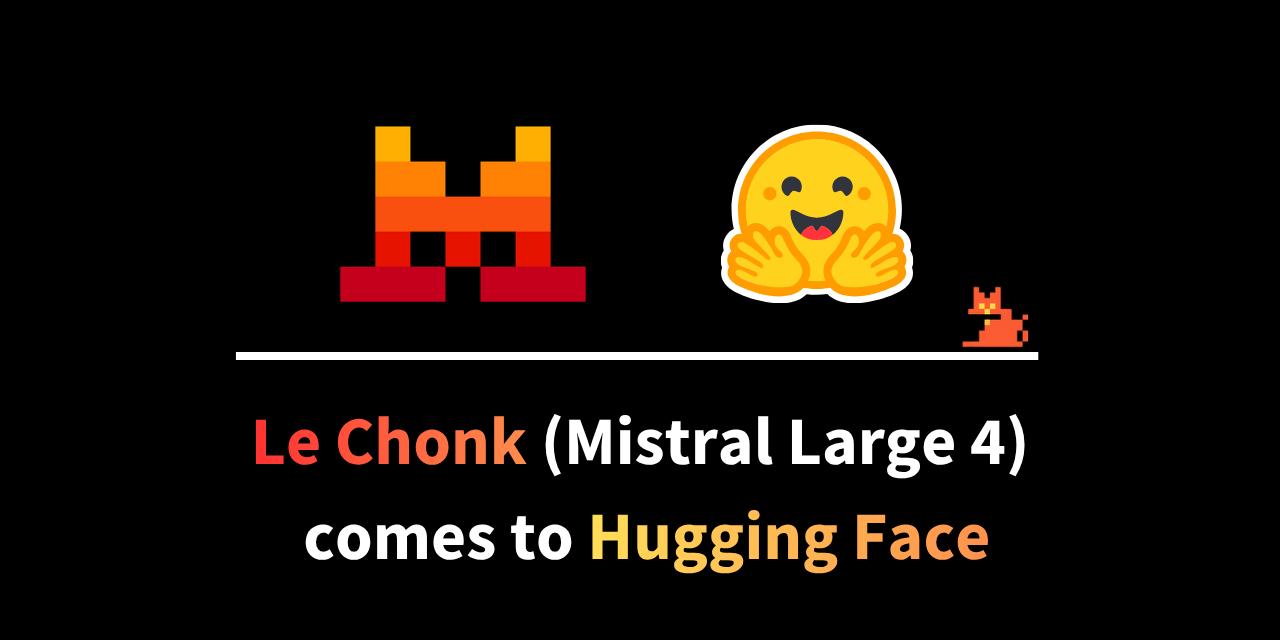
Mistral released the weights of Mistral Large 4 on Thursday, October 29, putting a mixture-of-experts model with roughly a trillion parameters on Hugging Face for anyone to download. The model, nicknamed “Le Chonk,” had been in public preview since October 6. Mistral says it spent the three weeks since then on more reinforcement learning aimed at two jobs, writing code and defending networks, and it titled the announcement “Built for Coders, Trusted by Defenders.”
Only a fraction of that trillion is used at any moment. According to the model card, 49 billion parameters are active per token, or 52 billion counting embeddings and output layers, because each token is routed to four of 128 experts plus one shared expert. The model reads text and images, writes text, handles a context of 1 million tokens and covers more than 160 languages. Mistral trained it from scratch on 3,800 Nvidia Grace Blackwell GPUs in its own European datacentres, and it offers low, medium and high reasoning modes, with high as the default.
“Open weights” comes with a condition here. The model ships under the Mistral Ecosystem Open-Weight License, a modified MIT licence rather than Apache 2.0. It allows use, modification, fine-tuning and commercial products, but a business that sells access to the model as a hosted service needs a separate commercial licence from Mistral.
The headline numbers are Mistral’s own, and the full technical report behind them is still listed as “coming soon.” Mistral reports 19.7% on Cognition’s private FrontierCode 2.0 and 41% on Terminal-Bench 4.0, 13 points above the preview while producing 30% fewer output tokens, and says both lead open-weight models. On the Artificial Analysis Coding Agent Index it reports 48%, which it calls effectively tied with GLM-5.3 while using 47% fewer tokens per task. For security work it cites 51% on the Artificial Analysis Cyber Index and an average refusal rate of 96.6% on the malicious cyber prompts in JailbreakBench, StrongREJECT and AgentHarm.
Artificial Analysis’s own model page gives a more modest overall picture. In high reasoning mode the model scores 26 on its Intelligence Index, ninth of 21 comparable models, a group Artificial Analysis limits to open-weight models above 150 billion parameters. It rates the model notably fast, at about 161 output tokens per second, but somewhat verbose.
The cyber pitch also comes with an admission. Mistral says it watched cyber-related use in live traffic after the preview, and that although the model refused black-box attacks against live targets, “we see a potential for uplift to conduct real attacks.” It says it’s changing its guardrails and will keep updating them. A more capable variant tuned for penetration testing, vulnerability assessment and red-teaming stays out of the public release. Only vetted enterprise partners such as Orange Cyberdefense get preview access, under contract and only against systems they own or are authorised to test.
Through Mistral’s API the model costs $0.70 per million input tokens, $0.07 for cached input and $2.10 for output, according to Mistral’s documentation. It’s also available in Mistral Studio, on OpenRouter, through Nvidia-hosted endpoints and a NIM container, and in Microsoft Foundry. Tina Schuchman, Microsoft’s corporate vice president for Foundry, says in Mistral’s post that Microsoft is “the first cloud provider to bring Mistral Large 4 to customers.” Mistral calls it its largest model to date, a step up from earlier products such as its enterprise coding assistant.
Running it yourself takes serious hardware. SGLang’s verified recipes serve the FP8 weights on eight Nvidia B300 GPUs, or a smaller NVFP4 checkpoint on four GB300s, and the NVFP4 version only runs on Blackwell chips. Hugging Face’s guide lists day-one support in vLLM, Transformers and llama.cpp, with heavily compressed GGUF versions from Unsloth and the llama.cpp team for people trying to squeeze it onto less.

ABOUT THE AUTHOR